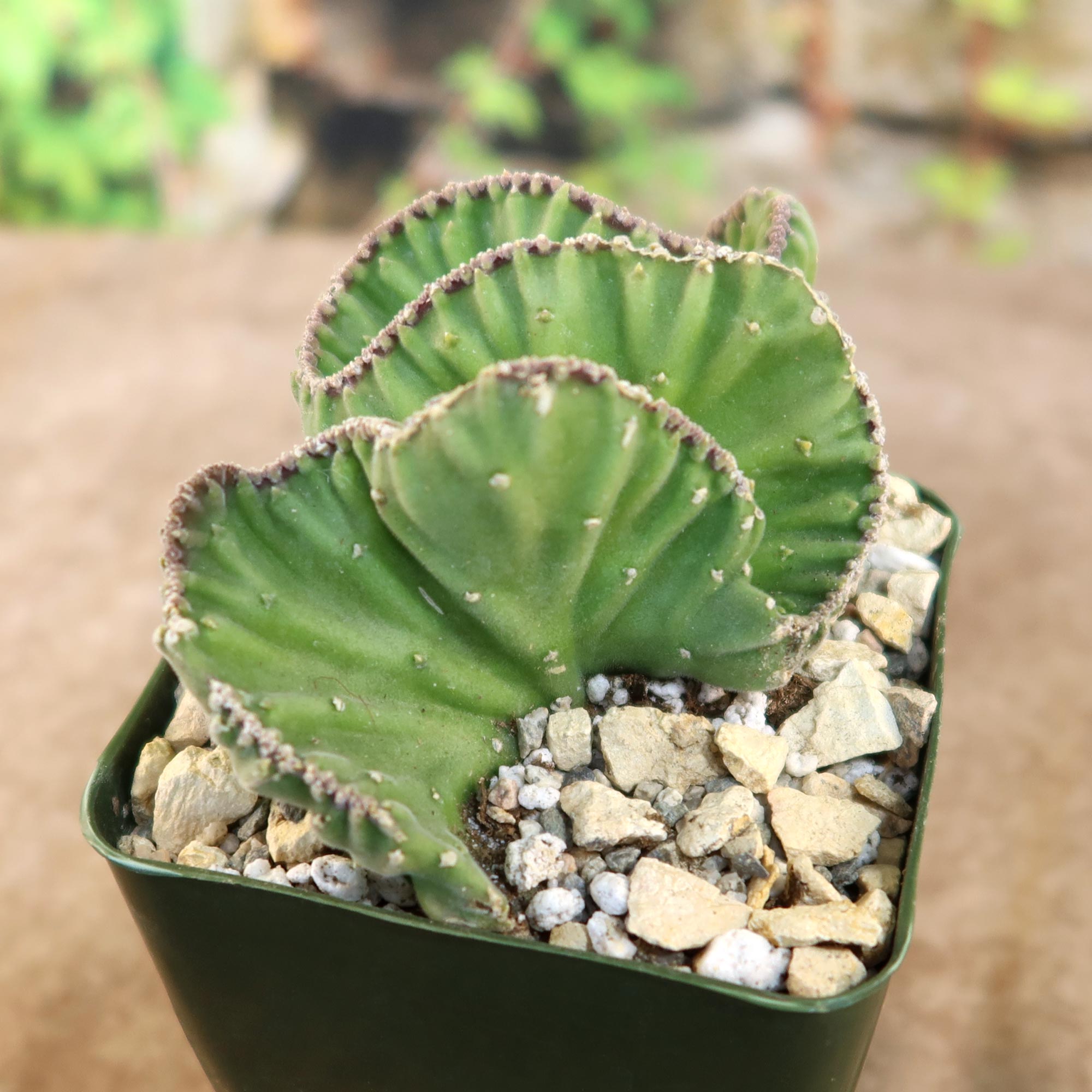
wavy succulent plant Stapelia leendertziae cristata
SKU: 5331577616
wavy succulent plant

wavy succulent plant Stapelia leendertziae cristata

Sale price$22.70 Regular price$25.22
Save 10%

Pay in installments of $6.30 with ShopPay, AfterPay and Klarna

Shipping Estimate
USA
  • USA
  • CAN

Ships within 48 hours · Estimated delivery Jul 5 - Jul 10

Promo Codes Available:

For Your Every Summer RSVP, with Code: SUMMER15

Description

wavy succulent plant Stapelia leendertziae cristataStapelia leendertziae cristata is a rare and striking crested succulent admired for its sculptural, fan shaped, water storing stems and dramatic, exotic flowers. As a crested form of Stapelia leendertziae, it is especially sought after by collectors due to its unusual growth pattern and bold architectural appearance. Its rarity, unique texture, and fascinating blooms make it a standout specimen in succulent and oddity collections. Native to South

Stapelia leendertziae cristata is a rare and striking crested succulent admired for its sculptural, fan-shaped, water storing stems and dramatic, exotic flowers. As a crested form of Stapelia leendertziae, it is especially sought after by collectors due to its unusual growth pattern and bold architectural appearance. Its rarity, unique texture, and fascinating blooms make it a standout specimen in succulent and oddity collections. 

Native to South Africa, the defining feature of Stapelia leendertziae cristata is its crested growth form, where stems fuse into wavy, fan-like ridges instead of growing upright. The fleshy stems are ribbed, gray-green to bluish-green, and covered with small, soft teeth along the edges. This crested structure gives the plant a dramatic, coral-like or sculptural appearance, making it highly ornamental even when not in bloom. 

This crested succulent remains moderate in size, typically grows up to 12 inches tall, and spreads up to 18 inches depending on growing conditions.

Its compact yet bold form makes it ideal for container growing, display pots, and specialty succulent arrangements.

One of the most remarkable traits of this species is its large, bell-shaped flowers, which are deep maroon to nearly black with a velvety texture.

The blooms appear in summer to early fall and are known for emitting a strong odor resembling decaying organic matter, which helps attract pollinating flies in nature.

When it comes to care, the Stapelia leendertziae cristata is drought-tolerant and prefers infrequent watering, allowing the soil to dry out completely between waterings. Overwatering should be avoided, as it can lead to root rot. A well-drained succulent soil mix, with added grit or perlite is essential. During the active growing season in spring, a light application of diluted NPK fertilizer once a year can support healthy growth

Indoors, this plant thrives in bright, indirect light or filtered sunlight, as intense direct sun can scorch the stems. Ideal indoor temperatures range between 65-85°F. 

Outdoors, it performs best in bright shade to partial sun and is suitable for USDA zones 10–11, where frost is minimal.

In cooler climates, it should be grown in containers and protected from cold temperatures below 50°F. 

The Bottom Line

Overall, the Stapelia leendertziae cristata is a rare, visually captivating succulent that appeals to collectors seeking something truly distinctive. Its crested form, bold structure, and dramatic dark flowers make it an exceptional focal point in succulent displays. With proper drainage, bright light, and careful watering, this unusual plant rewards growers with long-lasting beauty and an unmistakable presence. 

Shipping Notes
  • Free Standard Shipping on $100+ Orders to the USA.
  • Except Preorder products are shipped in 48 hours.
  • Delivery to the USA:
  1. Standard Shipping : 3-10 business days
  • If time is of the essence, please consider selecting expedited delivery for faster service.
Exchange/Return Notes
  • We offer a 30-day return/exchange service after receiving.
  • Final sale items are not eligible for returns or exchanges.
  • To process your return/exchange, please contact us at [email protected]
  • Please click here for more details>>> Return & Exchange Policy
SKU: 5331577616

Discover Niche Categories That Outsell wavy succulent plant

Top-Converting Item to Boost Your Average Order

4.3 ★★★★★
Based on 245 reviews
Sort
Highest Rating
Newest First
Oldest First
Product Reviews
C
Verified Purchase
Christian Schlect
Lexington, US
★★★★★ 5
The Fix
Format: Hardcover
An insightful and interesting book on how our country's first legislators try to make sense of the new and fairly short U.S. Constitution, which, being drafted by humans, was bound to be imperfect. A lack of clarity on some point might be due to the changeable nature of words themselves or to confusion or obscurity of thought by the authors. And, who were the authors? The men in the room who came up with the product or the various state conventions that approved the final product? Professor Gienapp writes well and with a fine grasp of his subject. He uses concrete examples to illustrate his main points. For example, Congressional debates over the constitutionality of a proposed federal bank, the ratification of Jay's Treaty, and even whether the Bill of Rights was to be incorporated into or simply added to the original document. Most people think of U.S. constitutional history in terms of its drafting and ratification and/or its later judicial interpretation by the Supreme Court. Here, Professor Gienapp focuses on the initial work of interpretation by the first few sessions of Congress. This book is essential reading for those interested in the U.S. Constitution and the internal architecture of our government. I think those who spend countless hours viewing frenetic talking heads say this or that about the constitutionality of some issue or another (or the nomination of a justice to the High Court) should throw their television set out the window and, instead, settle into a corner chair and calmly read this and other such thoughtful books. This one should win prizes.
WAS THIS REVIEW HELPFUL?YesReportShare
Reviewed in the United States on October 14, 2018
G
Verified Purchase
Gadavis
West Palm Beach, US
★★★★★ 5
Excellent Book
Format: Hardcover
Stanford University History Professor Gienapp has done an outstanding job of researching and writing this historical analysis of the interpretation of the American Constitution by America's first Congress. Professor Gienapp analyzes data primarily from Congress's problems interpreting the removable of executive officers, chartering a national bank and approval of the 1794 Treaty with Great Britain negotiated by Chief Justice John Jay, the "Jay Treaty." Gienapp shows in clear writing how Congress used records of the debates at the Constitutional Convention and State Ratification Conventions to resolve these constitutional issues. I highly recommend this book to anyone concerned with the interpretation of the American Constitution.
WAS THIS REVIEW HELPFUL?YesReportShare
Reviewed in the United States on July 18, 2020
G
Verified Purchase
Gary Y. Larsen
Los Angeles, US
★★★★★ 5
An analysis of how we came to think about the Constitution the way we do
Format: Kindle
It provides a detailed analysis of the arguments used to talk about the Constitution in the ten years after it was ratified. These arguments shifted from treating it as a preliminary draft to be perfected through filling in the details of the operation of the government through experience, to a sacred document that had to be interpreted to determine its "true" meaning.
WAS THIS REVIEW HELPFUL?YesReportShare
Reviewed in the United States on December 18, 2018
C
Verified Purchase
Connie Jones
Louisville, US
★★★★★ 5
Transcends the Historiography on the Constitution
Format: Hardcover
“This is the most important book to be written on the Constitution since Gordon Wood’s Creation.”
WAS THIS REVIEW HELPFUL?YesReportShare
Reviewed in the United States on May 9, 2020
M
moxielady
San Leandro, US
★★★★★ 2
I Really Wanted to Like This, But...
Format: Audiobook
My 2 star review is entirely due to the audio performance. While the premise and scholarly research in this book is fascinating, the narration is anything but. The narrator speaks, and at times even PERFORMS, every "quote" and "unquote" no matter where they are in the text. In a long (20 hours) book relying heavily on quotations, this narrative choice dramatically detracts from the listener's ability to absorb the material. One wonders why he doesn't say, "period," after every sentence! In addition, he sounds like he's spraying a lot of spit at the mike while speaking. Yes, euw. I listen to 3-8 audiobooks a week, and have done so since the early 1990s, so this isn't my first, or even my first scholarly, audiobook. The better narrators designate quoted text with a shift in vocal tone or slight pause. If you are considering this book, I hope you choose the print version.
WAS THIS REVIEW HELPFUL?YesReportShare
Reviewed in the United States on November 5, 2021

recommand products